
BASIC Studios
Monet’s “Grandes Decorations”: A Formal Analysis
Greetings, wandering soul! The Ink-stained Archivist welcomes you to the Library of the Lost—where, for each lost soul, a story might be found.
Is that a sketchbook I spy? Are you, by chance, an artist? I myself am a great admirer of those with an affinity for capturing magic on paper or canvas. Alas, the Muses did not bestow me with that particular creative talent.
Ah, but my manners have flown away from me in my excitement. Please join me in the drawing room for refreshments. I’ve prepared a modest charcuterie board for us to enjoy. Help yourself to the Camembert, truffles, artichokes, apples, pears, and figs. A basket of croissants, courtesy of the kitchen sprites, awaits your approval at the center of the table.
Ah! So you’ve noticed my framed photographs. Your eyes are not deceiving you, dear wanderer. Before you hangs a grainy image of yours truly nestled within Monet’s famous exhibit at the Musée de l’Orangerie, mere months after its installation.
You appear flummoxed, my friend. Is it my garb that troubles you so? I assure you, in the early 1900s, frocks with dropped waists were the epitome of high fashion. If you ask me, the silhouette suited me rather nicely. The hat, I’ll admit, was a bit eccentric for the time, but—My age? Dearest friend, you should know better than to ask a woman to reveal her age.
Now, where was I? Oh, yes, I was about to recount for you my review of Monet’s “Grandes Decorations.”
Monet’s Eight Canvases
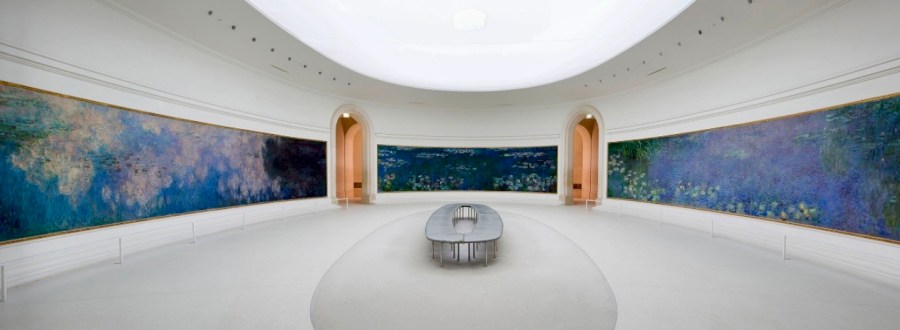
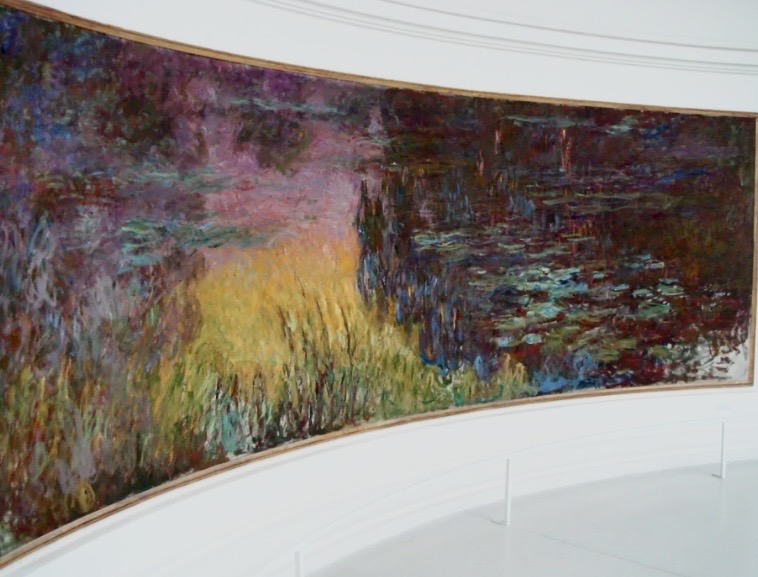
Upon stepping foot into this otherworldly exhibit, famously in residence at the Musée de l’Orangerie, the observer is enveloped on all sides by a serene waterscape. Each of Monet’s eight “grandes decorations” captures a particular time of day, and therefore conveys to the observer a quintessential mood. Myriad aspects of the encompassing, lush waterscape are emphasized in Monet’s dreamy renderings. Elements of form, texture, color, value, and space reveal a realm of all-encompassing tranquility. Depicted across these eight canvases is the surface of a pond strewn with delicate water lilies and shadowed by low-hanging willow branches. Reflections of delicate plant life and hazy clouds blur the watery image further. These eight astounding works were crafted in Monet’s signature Impressionist style, since lauded as one of history’s most influential artistic movements (Banijay Documentaries).

Form and Texture
All eight of Monet’s canvases are populated by countless organic forms: willow branches, clouds, and, of course, his beloved water lilies. The aforementioned forms predominantly occupy implied space—though the technique of layering paint favored by Monet, wherein paint rises from the canvases’ surface in select areas, inarguably consume real space. A combination of implied and actual textures are readily discernible in Monet’s expert technique, his meticulous brushstrokes, and his liberal layering of paint. As stated, examples of actual texture are noted in the layers upon layers of paint spread across the eight colossal canvases. This texture can be viewed, and, theoretically, experienced via touch—though the museum docents do tend to discourage visitors from caressing the exhibits. Implied texture is evident in the rippling surface of the water and in the forms depicting various plants. Movement of air across the surface of the water is also discernible to the keen observer.

Color
The colors used in the creation of these canvases can be observed in the natural world throughout the day and during various instances of weather. Care and attention were granted to the spatial arrangement of these eight canvases, the color palettes of which illustrate the captivating balance between nature’s untamable rhythm and an artist’s exacting orchestrations as explored by the illusion of time cast upon Monet’s waterscape. An easterly positioned canvas, for example, that depicts a sunrise features soft, light, airy hues, whereas a westerly-positioned canvas that depicts a sunset features rich, intense, vibrant hues. Though similar forms are often repeated across the eight canvases, the colors chosen to render them differ between iterations, seemingly to imply a shift in time, as well as a shift in quality of light. Expanses of sky are rendered in reflections across the pond’s surface, the colors hazier and softer, as if to imply the play of light on, and movement of, water. The skill with which Monet presents color and value—his rendering of light and shadow in relation to what appears to be ever-changing weather and time of day—breathes life and depth into these organic forms.

Space
Within his eight canvases themselves, Monet seemingly approaches space with meticulous haphazardness reminiscent of nature itself, which stands in contrast to the painstaking focus he exerted over his art installation at large. Expanses of negative space extend in irregular bursts between the clusters of organic forms. Meanwhile, positive space is occupied by myriad organic forms, typically rendered in multiples and interspersed throughout the eight canvases. Monet’s colossal, curved canvases hang in two oval rooms, with four canvases located in each (Banijay Documentaries). Installed side by side on each wall, these eight panels follow the rooms’ curving structure in order to promote a continuous, immersive experience to visitors. The walls, floor, and ceiling of the space surrounding the canvases are stark white, emphasizing the intensity of the canvases’ overall composition.

Skylights positioned above the canvases encourage observers to perceive them differently at various times of day and under numerous weather conditions, be it at sunrise or sunset, under storm or sunshine. Harmoniously aligned with the egg-shaped rooms, the eight canvases curve ever-so-slightly, as if to encircle observers. These eight canvases each measure at approximately six feet by fourteen feet, covering a surface area of 2,153 square feet (History of the Water Lilies Cycle). The canvases’ heights measure at roughly 6.5 ft, but differ in length (History of the Water Lilies Cycle). To comprehend them, one must observe these tremendous panels in their entirety, from the shape of the elliptical, infinity-shaped room, to the play of light through the skylights above, and the imposing majesty of the panels’ breadth themselves.
Conclusion
Would you care to hear more about the artist who crafted these eight bewitching masterpieces?
Wait, why are you fleeing with such haste? I urge you to refrain from barreling through the gallery so errantly. Your haphazard gait invites calamity.
Dear me, I’ve done it again: another poor, unfortunate wanderer has fallen upon the sword of my preoccupation with Monet. Oh well, mayhap you’ll find yourself at the Musée de l’Orangerie one day. If you do, give the water lilies my best.
If you’ve enjoyed this moment of artistic mischief, please consider subscribing to our blog. Each time we publish a new article, a grumpy, technologically skilled wizard will instantly notify you. But please do not ask me to explain how any of that arcane nonsense functions—in fact, I refuse to do so, lest I embarrass myself.
Your Ink-stained Archivist bids you farewell, dear wanderer.
Works Cited
“A Phenomenology of Display: Monet’s L’Orangerie, The Panorama Rotunda, and the History of Proto-Installation Art” by Anthony Portulese – Rutgers Art Review. (n.d.).
KQED Art School. “Elements of Art: Color | KQED Arts.” YouTube, 16 Jan. 2015.
—. “Elements of Art: Form | KQED Arts.” YouTube, 14 Oct. 2014.
—. “Elements of Art: Space | KQED Arts.” YouTube, 2 Feb. 2015.
—. “Elements of Art: Texture | KQED Arts.” YouTube, 20 Nov. 2014.
Monet, Claude. Water Lilies. 1914-1926. Musée de l’Orangerie, Paris. Musée de l’Orangerie. fr,.
Discover more from BASIC Studios
Subscribe to get the latest posts sent to your email.
You must be logged in to post a comment.