
BASIC Studios
Of Witches and Goddesses: The Warren Line
Greetings, wandering soul! The Ink-Stained Archivist welcomes you to the Library of the Lost—where, for each lost soul, a story might be found.

But my oh my, you’ve travelled so far across time and space to see me here today. I must forewarn you that there is currently a guest—besides yourself, of course—within these hallowed halls. My old friend—you likely know her as the Monster Mama—is visiting the cats and me as we usher in this autumn’s bountiful harvest. While she rests, perhaps I might convince you to sit a spell with me and discuss the fascinating parallels we might discern between various feminine Greek deities and a few of our most favorite fictional witches?
Marvelous!
Rest beside me now and I’ll pour you a cup of chamomile tea. Oh, and do help yourself to a freshly baked chocolate chip cookie, dear wanderer. This little snack is, of course, inspired by one of our—that is to say, my feline companions and me—personal favorite witchy television shows from the late 1990s and early 2000s. Naturally, I’m speaking of Charmed.

Melinda Warren
Fans of the television series will no doubt fondly recall the Halliwell line of witches’ lore, which began with Melinda Warren, born October 31st, 1670. Melinda Warren planted the seed of what would become the Halliwell matriarchal legacy. With that in mind, it seems only fitting to compare her to Gaia, the primordial personification of the earth itself. As both the literal and metaphorical mother of all born upon the earth and the primary matriarch to all future life ad infinitum, the parallels between Gaia and Melinda are obvious—too obvious, really. For that reason, I believe the subtler choice is far more fitting. Ananke, the primordial manifestation of necessity, inevitability, and compulsion, born instantaneously at the dawn of creation, is a far more interesting comparison, don’t you think? In Plato’s Republic, he describes Ananke as the mother of the Fates. Orphic theology features her more readily than more traditional Greek mythologies and most frequently portrays her as a personification of necessity rather than an abstract concept. As I’m sure you’ve guessed, what strikes me most about Ananke’s ancient attributions is her tether to inevitability, necessity, and the Fates. The Charmed Ones, three sisters of immeasurable power, as the Fates were born of Ananke, were born of the Warren line of witches. Their prophesied rise to greatness was necessary to restore balance between the forces of good and evil. The birth of three gifted witches who carried Melinda Warren’s blood was inevitable.
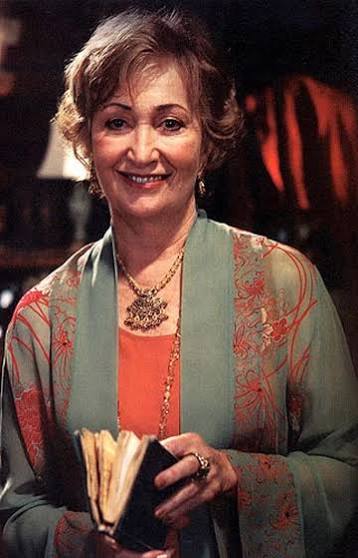
Penelope “Grams” Halliwell
The modern branch of the Warren line stems from its ghostly matriarch, Penny “Grams” Halliwell. As grandmother of the Charmed sisters, Penny Halliwell protects and guides her family—both the living and the dead—even after she herself has died. If we judge her solely based on her role as her family’s primary keeper of magical knowledge and as a formidable witch in her own right, we’ll swiftly conclude that Penny is an easy parallel of Hecate, the Greek deity most famously associated with witchcraft. However, there is a far more fascinating comparison to be found. Mnemosyne, the Titan goddess of memory, who preserved knowledge and tradition before written language developed, embodies everything that Penny represents to her family.

Prudence “Prue” Halliwell”
Eldest of the original three Charmed Ones, Prue Halliwell possessed the powers of Telekinesis and Astral Projection before being prematurely slaughtered during a battle with Shax, the demon assassin sent to slaughter the Charmed Ones. I think most fans of the show will agree with my assessment here; there is really only one appropriate suggestion for Prue. Athena, the Olympian goddess of wisdom, strategic warfare, and crafts, is known for her intelligence, cleverness, resourcefulness, and reason. Prue, too, proved herself time and time again to be a wise, strategic thinker. Her discipline, natural leadership skills, and sense of duty align her firmly with Athena’s essence. Her chosen profession as an appraiser of antiques, art, and artifacts ties her even more thoroughly to Athena.

Piper Halliwell
Second eldest sister in the original trio of Charmed Ones and eventual eldest surviving sister, Piper Halliwell possessed the powers of Molecular Combustion and Molecular Immobilization. Now, some will take a cursory glance at Piper and attribute her role as the figurative hearth, heart, and home of her family to an obvious link to Hestia, the virgin goddess of the home, hearth, and domesticity. But in doing so, we are ignoring the raw, unshaking power of Piper’s protective spirit and the stubborn nurturer’s role she inhabits within the Halliwell family well into her golden years. Demeter, not Hestia, is the essence Piper wields. This Olympian goddess of agriculture is often associated with motherhood and nurturing. When her beloved daughter Persephone was stolen by Hades, Demeter scoured the realm in an effort to retrieve her. Similarly, Piper would go to the ends of the earth for her sisters. In the course of the show, she entered the Underworld, summoned the dead, and rewound time to secure the safety of her loved ones. She is the archetypal maternal protectress of the Halliwell family; this was beautifully, poignantly illustrated when she bore Wyatt, the first child in the next generation of Halliwells. Clearly, the writers agree with this assessment. In the episode, “Oh My Goddess!” Leo imbues each of the Charmed Ones with divine power. Piper, as you might imagine, is blessed with the powers of an earth goddess.

Phoebe Halliwell
Originally the youngest sister among the trio of Charmed Ones and the eventual middle sister, Phoebe possessed the powers of Premonition, Levitation, and Empathy. Phoebe’s tumultuous romantic life, as most fans are aware, was a main thread throughout the series. For that reason alone, some might attempt to associate her with Aphrodite, the goddess of love. True, Phoebe’s romantic misadventures defined her character arc, and her tendency to allow her heart to guide her choices furthered her character development for good and ill in turn. My final determination for Phoebe is a touch more nuanced, however. Persephone, daughter of Demeter and queen of the Underworld and a goddess of spring, is duality personified. Phoebe, too, is a balance of contrary, seemingly naturally contrary forces. In direct opposition to her role as a Charmed One, a force for good and a defender of innocents, Phoebe sat beside Cole, the Source of All Evil, and served as his queen in the Underworld. This is a balance—between that of a mortal advice columnist and a supernatural vanquisher of evil—she maintained throughout her arc. Of all of the Charmed Ones, Phoebe most seamlessly embodied duality and contradiction, balancing her professional success, her duties as a witch, and her loyalty to her sisters.

Paige Matthews
Secret fourth sister and half-whitelighter, Paige Matthews possessed the powers of Telekinetic Orbing, Orbing, and Healing. If we focus solely on the whitelighter side of her magical makeup, Iris, messenger goddess of the rainbow, would be a radiant fit for Paige. But in doing so, we would neglect Paige’s witchy heritage. In order to encapsulate her essence in totality, we must weigh all of Paige’s aspects. Therefore, I present you with a rather ambitious suggestion: Paige is Artemis. The Olympian goddess of the hunt, wildlife, the wilderness, and chastity, Artemis was a protector of the vulnerable, a warrioress, and a force of untamed authority. In her role as a social worker, Paige protects women and children, much like one of Artemis’ aspects. Similarly, she liaises with the magical community on the Halliwell family’s behalf, protecting and guiding magical creatures with grit and determination.
But I’ve blathered on long enough, haven’t I? My dearest Monster Mama is likely wondering where I’ve meandered off to in the time it took her to refresh herself. I must go and retrieve her before the halls of the Library swallow her whole.
If you’ve enjoyed this moment of magical mischief, please consider subscribing. Each time we publish a new article, a mysterious, technologically gifted wizard will immediately notify you. But please do not ask me to expound upon how any of that nonsense is achieved; I would, in my befuddled ineptitude, only embarrass myself.
Your Ink-stained Archivist bids you farewell.
Works Cited
Charmed. Created by Constance M. Burge, The WB, 1998–2006.
Griffith, Tom (2000). Plato: The Republic. Cambridge University Press.
Hesiod. Theogony. Translated by H. G. Evelyn-White, Harvard UP, 1914.
Ovid, Metamorphoses. Translated by Brookes More, Cornhill Publishing, 1922.
Discover more from BASIC Studios
Subscribe to get the latest posts sent to your email.
You must be logged in to post a comment.