

The Moon princess and her echos across anime

Long before stories were told using visual media like anime, much like the rest of the world, Japan told stories and myths through word of mouth, using them as avenues to explain things not well understood at the time. Through these myths, people learned how to live with uncertainty, loss and longing, using shared stories to feel less alone in the world. In Japan, many of these early stories were called Monogotari, or rather an extended prose narrative, much like the Epics of long ago. They were almost always fictional, even when retelling historical events.
One such tale, and probably the most prominent, is The Tale of the Bamboo Cutter. While the eventual author is unknown, this piece of Japanese folklore, finally written down on paper during the Heian Period ( 794 – 1185 ), transcends time, its influence still being seen today, especially in anime. And, despite its age — being considered Japan’s oldest surviving narrative — the story of the bamboo cutter and Princess Kaguya-hime, meaning Shining Princess, or Kaguya for short, continues to pulse through the minds of modern society.
THE GIST OF IT
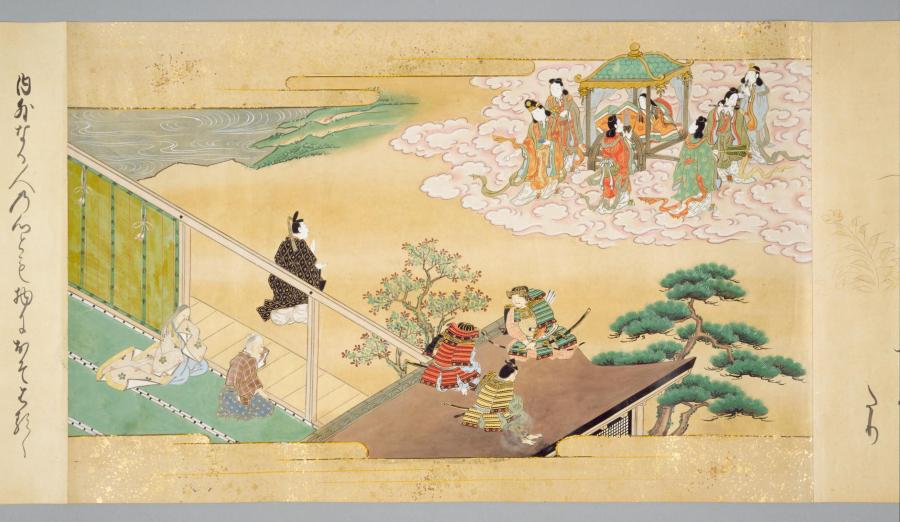
But, what is the story of the bamboo cutter and who is Princess Kaguya? Well, I’ll give you the gist of it —
The story begins rather simply, with an old bamboo cutter finding a glowing stalk of bamboo with a small girl inside. He and his wife decide to adopt her and raise her as their own and she grows to be extraordinarily beautiful, so much so that various noble suitors flock to their residence to ask for her hand. But because attachment conflicts with Kaguya’s eventual fate, she has to learn to become detached from earthly desires and therefore none of their gifts or propositions could interest her. And, while gold was found inside each bamboo stalk the old man would cut down, throwing her family into the throes of wealth and status, not even her newfound prosperity nor her growing attachment to the Emperor who loved her could anchor her to Earth. When it was time for her to go — when Celestial beings came to take her away, back to her true home, the Moon — she left. But not without leaving behind a letter and vial containing an elixir of immortality for the Emperor, with whom she had previously exchanged letters for 3 years.
Ultimately, heartbroken by the events, the Emperor has the letter and elixir burned atop the highest peak, as closest to the heavens as he could get, because he couldn’t bare the thought of continuing to live for an eternity if he could not be with her.
OKAY, AND?
But what about this story moves people to the point of holding onto it and retelling it for centuries? Is it simply cultural preservation? Is it the heart-aching “love story that could’ve been” between two beings so fundamentally different? The themes of sacrifice, or the relatable feeling of longing for one’s true home?
One cannot be so sure as to accurately pinpoint a single reason, as each listed above and the plenty more themes explored in the story still ring true for each new generation. Which is precisely why her tale is still revisited and drawn upon today; with the two most notable renditions being Studio Ghibli’s The Tale of Princess Kaguya and, while having an ultimately very different interpretation, the infamous final villain of the main Naruto series, Kaguya Otsutsuki.
STUDIO GHIBLI’S PRINCESS KAGUYA

Directed by Isai Takahata, 2013’s The Tale of the Princess Kaguya is one of the more faithful anime retellings of The Tale of the Bamboo Cutter. Sticking to its mythical and traditional roots, the studio chose to resemble ancient Japanese ink paintings, using a watercolor-like art and animation style. Though, notably, the studio chose to explore her emotional state more intentionally and deeper than earlier told versions, as those often portrayed her as rather distant and resigned. They flesh out the story, exploring her childhood and she becomes a fully realized, emotionally resonant being in Ghibli’s rendition of the tale, and through this lens, modern audiences can better relate to her, strengthening the longstanding connection with her story with newer audiences.
THE CONTROVERSIAL KAGUYA OTSUTSUKI

Not so much the gentle and beautiful Princess of the Moon like the more traditional Kaguya-hime, Kaguya Otsutsuki is the godlike final antagonist of the main Naruto series. While her appearance in the final arc of Naruto Shippuden remains controversial even years after its ending, as the progenitor of Chakra, she remains a significant part of the verse. But without divulging into Naruto’s extensive and rather confounding lore, lets just stick to how exactly Masashi Kishimoto took inspiration from the tale, and where he veered off track, creating his own unique character—
Much like her more traditional counterpart, Kaguya Otsutsuki, too, isn’t from earth, but where they differ is: while Kaguya-hime is from the moon, Naruto’s Kaguya is from a different dimension entirely. And, while Kaguya-hime was essentially forced to leave earth against her will, Kaguya Otsutsuki refused to give up the power she’d gained and never accepted the beauty of impermanence, as her counterpart learned to do. And, rather than sacrificing immortality for love, Kishimoto chooses to frame the obsession with it as a curse that only leads to one’s own demise.
Final Thoughts
Though Studio Ghibli and Kishimoto’s versions are arguably the most well known, they aren’t the only reinterpretations. Other notable shows or films have incorporated aspects of her story into their own, morphing antiquity and tradition with modern storytelling to create unique characters and storylines. Stories such as Sailor Moon, Queen Millennia, Mushishi and Inyuyasha to name a few, furthermore showcasing that even after centuries The Tale of the Bamboo Cutter and Princess Kaguya still inspire new generations.
From word of mouth, to scrolls and woodblock prints, to eventually television, anime has become the modern continuation of this tradition, reimagining Princess Kaguya through gentle, heartfelt retellings like Ghibli’s 2013 film or darker inversions like Kishimoto’s final villain of his magnum opus. Though her form changes, the core of her story often remains; longing, loss and the beauty of impermanence. As long as people can relate to her tale, she will never truly disappear from our minds, her story will simply be retold.
But while that’s all I have for you today, I invite you to visit again for more quick readings from your resident anime interpreter!
Want to explore more about this topic? Here you go:
The Tale of the Bamboo Cutter Scroll
The Tale of Princess Kaguya, Film
Discover more from BASIC Studios
Subscribe to get the latest posts sent to your email.


Leave a Reply