
BASIC Studios
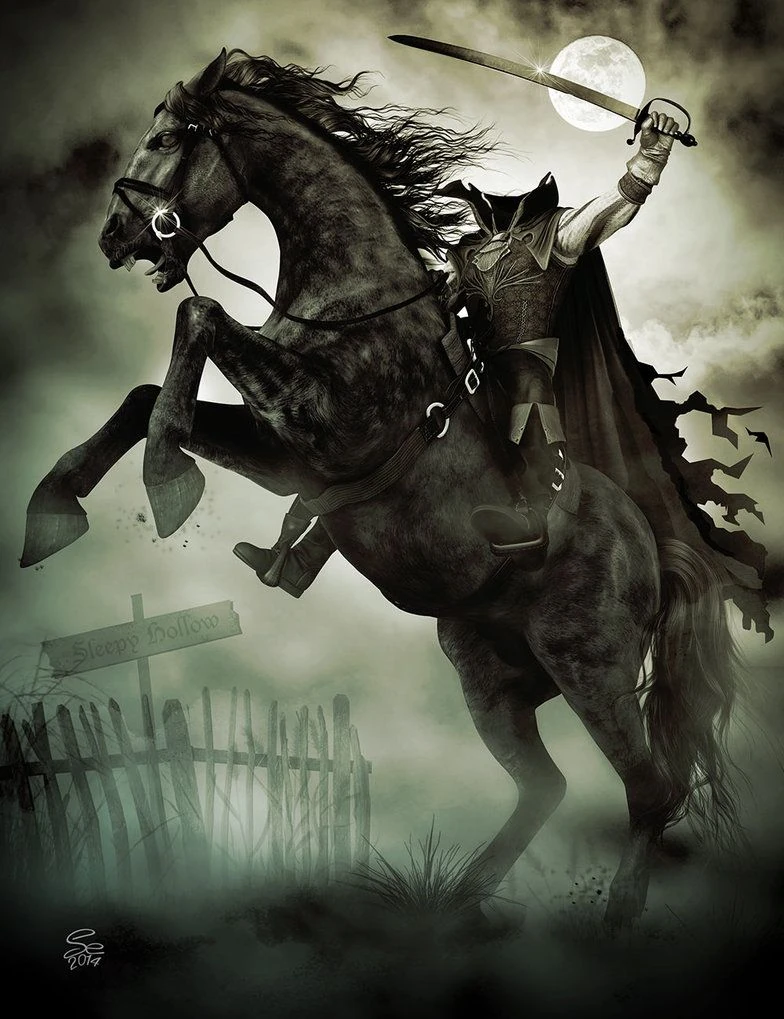
The Headless Horseman
It is already October, and by now many monstrous figures have been popping up: vampires, werewolves, Frankenstein’s monster, and ghosts. These monsters are all classic staples of the Halloween holiday. But there is one legendary figure that resides among the ghosts and banshees, a figure that has been around ever since colonial times thanks to America’s first-ever ghost story.
The figure is the infamous Headless Horseman, a creature that some would be surprised to learn did not originate in the Americas. The Headless Horseman has been terrifying people in Europe since the Middle Ages before finding its way to the Americas. Like all mythology, several versions have been told and retold throughout the years. So let us dive into the history and mythology of the ghostly figure known as the Headless Horseman.
Early Tales
The earliest tale of a Headless Horseman is from an Arthurian poem titled, “Sir Gawain and the Green Knight.” In the poem, a giant green horseman rides into King Arthur’s halls, issuing a challenge that anyone may strike him once with an axe, but he would have to face the same blow in a year and a day. A young knight named Sir Gawain accepts the challenge and decapitates the man with the axe. Instead of falling over, the man picks up his decapitated head and reminds him of the deal, before galloping away.
As the day approaches, Sir Gawain sets off to look for the Green Knight to keep his end of the challenge. The Green Knight revealed he had been transformed by Arthur’s half-sister, Morgan le Fay, and issued the challenge as a test to see how chivalrous Arthur’s knights were.

In Scotland, the Headless Horseman was said to be Ewen of the Little Head, son of the Chief of the Maclaines. Encouraged by his wife, Ewen demanded more lands from his father. He was denied, leading to arguments between father and son until a duel was issued between the two and their followers. On the night before the battle, Ewen encountered a washerwoman who warned him that if he was not served butter with his breakfast, he would be killed in battle. The next morning, butter was not served with breakfast, but Ewen decided to go ahead with the battle. During the battle, Ewen recklessly charged ahead and was decapitated while still riding on his horse. Terrified by the battle, Ewen’s horse ran from the battlefield while Ewen’s headless body remained in the saddle. Eventually, the exhausted horse stopped on top of a steep slope where Ewan’s followers then buried him. It is said that Ewen still haunts the area today. Some have even said they have heard the sounds of a galloping horse.
The Dullahan
In Irish mythology, the Dullahan or dulachán, was said to be a dark fairy and the harbinger of death. The origin of the legend might have developed from the ancient Celtic god of fertility, Crom Dubh. Chrome Dubh would demand sacrifices from his followers, specifically sacrifices that required the victim to be decapitated. When Christianity came to Ireland and spread, the sacrificial ceremonies were stopped, yet some say that the god of fertility took another terrifying form to search for the sacrificial souls he desired. The Dullahan takes the form of a man dressed in all black and rides a black horse. Others claim that he actually rides a coachwagon made of human bones pulled by six black horses, like a hearse to carry the dead to the afterlife. Some stories say that the head is completely missing while others claim he carries his severed head under his arm or holds it aloft. The head is described to be covered in rotting flesh and has a terrifying grin on its face. The burning eyes moved from left to right as if searching for his victims. The head is also said to have supernatural powers, allowing the horseman to view great distances while scouting the lands. Once the Dullahan locates his next target, there is no stopping him. HIs victim will not be able to hide from him or keep him away by locking the doors. All the Dullahan needs to do is speak the name of his victim and they will drop dead without another word. Even those who are lucky to live another day still may not be lucky at all. Those who look upon the Dullahan are immediately blinded, either by having a bucket of blood thrown into their eyes or by having their eyes whipped off by the Dullahan’s whip made of a human spine.
While death is inescapable, there is a way to protect yourself from the Dullahan. The Dullahan is said to fear the precious metal of gold; even a tiny piece of gold such as a coin or a ring, would repel him and make him flee. Those who could afford it would carry gold coins or wear jewelry made of gold for protection.
The Legend of Sleepy Hollow
In March of 1820, a short story was published and would capture the imaginations of both adults and children for the next two-hundred years. The story was titled “The Legend of Sleepy Hollow” and is considered one of America’s first ghost stories.
Set in 1790 in Sleepy Hollow, New York, the story tells of a schoolteacher named Ichabod Crane who desires to win the hand of Katrina Van Tassel, the daughter of a wealthy and prosperous family. Another suitor, Braum Bones, also desires to win Katrina’s affections, causing a great rivalry between the two suitors. One night, after a party of ghostly tales, Ichabod tries to return home, but is chased by a horseman in black. Ichabod mysteriously disappears, leaving behind a hat and the remains of a shattered pumpkin. With Ichabod out of the way, Brom marries Katrina and the townspeople whisper that Ichabod was taken away by the Headless Horseman.

Washington Irving, the author of the short story, was born on April 7th, 1783 in New York City to two Scottish immigrants. During the years between 1815-1820, he traveled abroad to Europe and wrote back to his friend about all of the wonderful stories he had heard throughout his travels. During a trip to England, Irving became friends with fellow writer, Sir Walter Scott. The two discussed Scott’s poem titled “The Chase,” which was a translation of a German poem “The Wild Huntsman.” In the poem, a huntsman is doomed to be hunted for eternity by the Devil and his hellhounds as punishment for his crimes and sin, thus giving Irving the inspiration to write his own short story of a lone teacher being hunted by a ghostly horseman.
A Historical Clue
Of course, while the stories of horsemen were inspired by European folklore, it is said there is a bit of American history mixed within as well. In his story, Irving described the Headless Horseman as the ghost of a Hessian soldier who died when a cannonball struck his head during an unnamed battle at the time of the Revolutionary War. While this may seem like an exaggerated fictional tale, evidence was found to prove it may have very well happened. During the Revolutionary War, Hessian soldiers were German mercenaries hired by the British to fight against American colonists. During the war, George Washington suffered an immense defeat at the Battle of Long Island and ordered his troops to prepare a defense at a small settlement named White Hills. On the first of November, 1776, Hessian and British troops advanced upon American troops, but had to retreat due to hidden troops opening fire upon them. One soldier stood on top of a hill overlooking White Hills and fired a single cannonball at the Hessian troops. General William Heath wrote in his memoir that the shot decapitated one Hessian soldier while a horse was also left for dead in the field.
White Hills is only ten miles away from Irving’s home of Tarrytown, so it is possible he may have heard the tale of the battle. However, there is no evidence suggesting that this story was the main inspiration for the Headless Horseman in his story, but it is a very interesting coincidence.
The Legacy of the Headless Horseman
Two-hundred years since Irving had published “The Legend of Sleepy Hollow,” the story and its main ghost are still a main staple of Halloween tradition and other forms of media. In 1949, an animated adaption of the story was produced by the Walt Disney Company with Bing Crosby as the narrator. While the film was more lighthearted, many children were traumatized when the Headless Horseman appeared to chase Ichabod, thus introducing many of them to the legend.
In 1999, Tim Burton directed a live-action film of the story with Johnny Depp starring as Ichabod Crane. Instead of a schoolteacher, Ichabod is now a skeptical police constable investigating a series of decapitation murders in Sleepy Hollow that are said to be the work of the ghostly Headless Horseman.
In Sleepy Hollow and Tarrytown, there is a week-long festival celebrating the story with pumpkin carvings, dramatic renditions of the story, ghost tours, and a parade. The main highlight features the appearance of the Headless Horseman himself riding near Sleepy Hollow Cemetery and the Old Dutch Church. Several haunted hayrides take the theme of the Headless Horseman, with the decapitated ghost always appearing in a grand finale and giving chase to the victims in the wagon. Even in Disney World during Halloween, the Headless Horseman rides through Liberty Square before Mickey’s-Not-So-Scary Halloween parade.
With Halloween fast approaching, the Headless Horseman will lead the parade of monstrous creatures, so make sure to stay home at night, or else you’ll come face to face with the Headless Horseman looking for a head to chop.
After all, you can’t reason with a headless man.
Discover more from BASIC Studios
Subscribe to get the latest posts sent to your email.